
 Image 1 of 1
active - reaction - actually
< act > "do, perform"
To understand words for reading, spelling, comprehension and vocabulary, our students need to understand how they work. Specifically, they need to know that written words are not merely a transcription from speech to print.
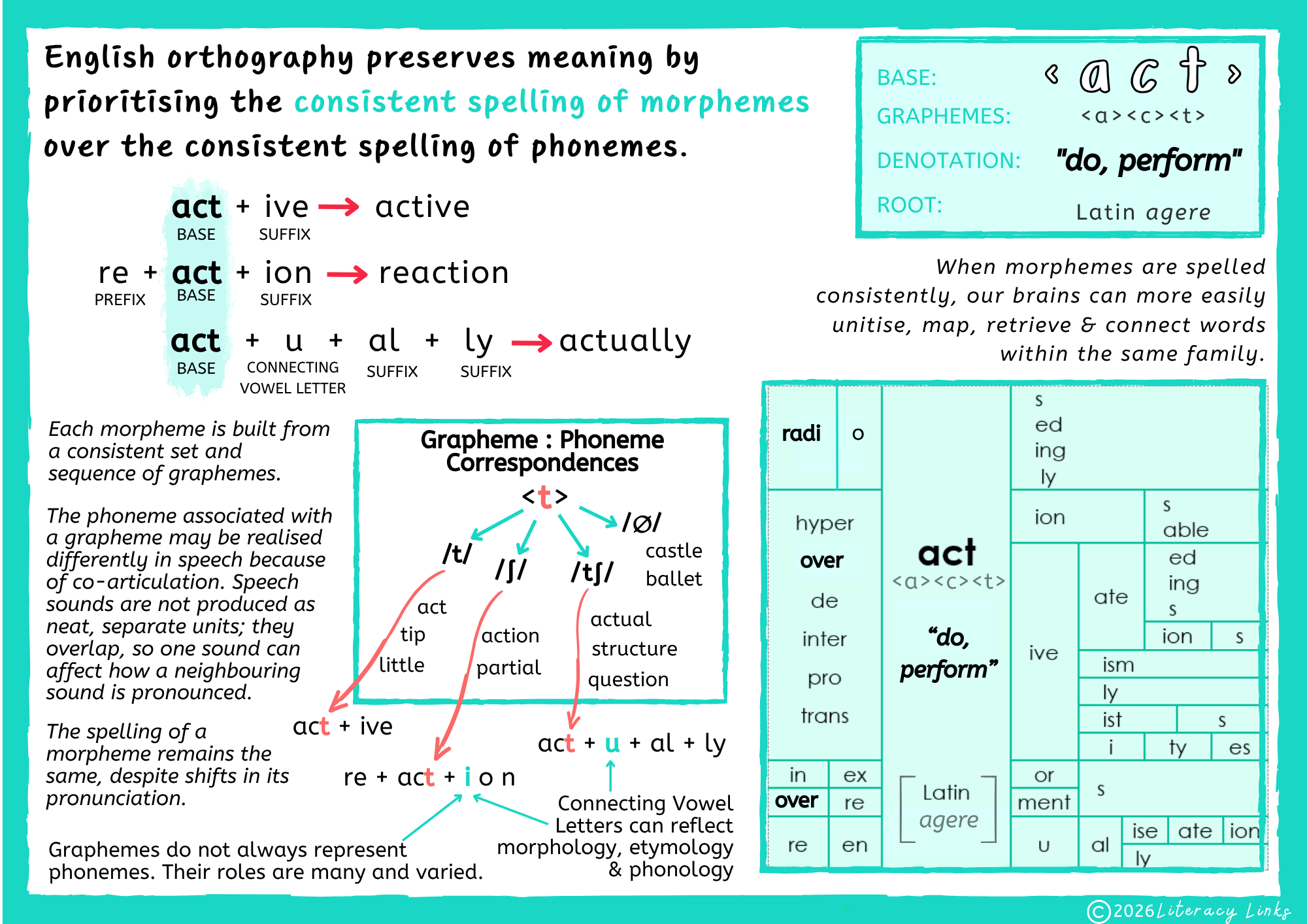
Speech & writing each have their own distinct 'operating system'. In the case of written language, each word is driven by an interrelationship between morphology, etymology and phonology. Words are built from morphemes, which are built from graphemes, and graphemes, do more than represent phonemes.
Learning about a word within the context of its morphological/base family, opens up endless opportunities for understanding not just that one word, but ALL of the words that are related to that one word AND the entire system itself. Once you have that understanding, it can be applied to an endless number of words.
Being able to respond to students' questions or errors such as these is really important:
how do we know that the suffix of 'action' is <-ion> and not *<-tion>?
why aren't words like 'action' spelled <acshun> and 'actually' spelled <ackchewly> to match the way they sound when we say them?
why is the <t> in 'act', 'action' & 'actual' pronounced differently?
what is a connecting vowel letter?
why is English spelling complex, & how can we ensure our students see the logic in it?
what is the <i> doing in 'action'?
why don't all graphemes represent phonemes?
In this one-page infographic, I've tried to represent all of the above concepts, and more!
Please get in touch if you have any questions!
Note: This resource reflects my current understanding. Learning is lifelong!
active - reaction - actually
< act > "do, perform"
To understand words for reading, spelling, comprehension and vocabulary, our students need to understand how they work. Specifically, they need to know that written words are not merely a transcription from speech to print.
Speech & writing each have their own distinct 'operating system'. In the case of written language, each word is driven by an interrelationship between morphology, etymology and phonology. Words are built from morphemes, which are built from graphemes, and graphemes, do more than represent phonemes.
Learning about a word within the context of its morphological/base family, opens up endless opportunities for understanding not just that one word, but ALL of the words that are related to that one word AND the entire system itself. Once you have that understanding, it can be applied to an endless number of words.
Being able to respond to students' questions or errors such as these is really important:
how do we know that the suffix of 'action' is <-ion> and not *<-tion>?
why aren't words like 'action' spelled <acshun> and 'actually' spelled <ackchewly> to match the way they sound when we say them?
why is the <t> in 'act', 'action' & 'actual' pronounced differently?
what is a connecting vowel letter?
why is English spelling complex, & how can we ensure our students see the logic in it?
what is the <i> doing in 'action'?
why don't all graphemes represent phonemes?
In this one-page infographic, I've tried to represent all of the above concepts, and more!
Please get in touch if you have any questions!
Note: This resource reflects my current understanding. Learning is lifelong!